
How To Install Glm For Mac
понедельник 24 февраля
How To Install Glm For Mac 9,1/10 8989 votes
Mou Review - The latest markdown editor for Mac that I have found and it has a preview pane built in and loads of markdown and multi-markdown writers features Good and Geeky Amazon Author Page.  On AppleStore there are two applications of the same author (luo xiao): Mou v. 1.1.0 $6.99 and Markdown––Jane and Beautiful v. 1.1.2 $10.99. On the other hand, CEO of 24.io is Chen Luo. Not sure if it is the same person. MacDown is an open source Markdown editor for macOS, released under the MIT License. It is heavily influenced by Chen Luo’s Mou. This is how it looks. One of my favorites is Mou: a relatively new markdown editor for Mac. This editor uses a simple two-column interface that shows the editor in one side panel and the preview of your formatted text in the other, making it nice for those new to markdown. Mou /məʊ/ is a Markdown editor for developers, on Mac OS X. Features live preview, sync scroll, auto save, powerful actions, auto pair, custom themes and CSS, HTML and PDF export, enhanced CJK support and more.
GLM tutorial in Excel. In this module, we will demonstrate the steps to construct a GLM model, calibrate it with the data and estimate values for intermediate points. Related articles. How do I use NumXL functions in my Excel sheet? Where can I download free trial of NumXL? Step One: Boot From Recovery Mode, or an Installer. RELATED: 8 Mac System Features You Can Access in Recovery Mode Your Mac’s Recovery Mode is a treasure trove of useful tools, and it’s the easiest way to wipe your computer and start from scratch. Shut down your Mac, turn it on while holding down Command+R.
About the App
- App name: tkdiff
- App description: Graphical side by side diff utility
- App website: Not Available
Install the App
- Press
Command+Spaceand type Terminal and press enter/return key. - Run in Terminal app:
ruby -e '$(curl -fsSL https://raw.githubusercontent.com/Homebrew/install/master/install)' < /dev/null 2> /dev/null
and press enter/return key.
If the screen prompts you to enter a password, please enter your Mac's user password to continue. When you type the password, it won't be displayed on screen, but the system would accept it. So just type your password and press ENTER/RETURN key. Then wait for the command to finish. - Run:
brew install tkdiff
Done! You can now use tkdiff. Amazon music unlimited download.
Similar Software for Mac
- In Visual Studio, create a Visual C++ 'Win32 Console Application'.
- In the 'Win32 Application Wizard', under 'Application Settings', check 'Empty project'. (The default is 'Precompiled header'. You don't need it.).
- After the project is created, right click on the project name and select 'Properties'.
- In the 'Property Pages' window, click Linker --> Input, and add the following files to the 'Additional Dependencies' line: freeglutd.lib glew32d.lib SOIL.lib assimp-vc140-mt.lib .
- Don't just copy the file names above. Your file name may be different from this example. For example, your files may be freeglut.lib and glew32.lib. So make sure your file names are correct.
- Note that since Visual Studio 2015, you no longer need to include opengl32.lib in 'Additional Dependencies'.
Figure 6. Configure a Visual Studio project for OpenGL.
- If you use Assimp, glm, or SOIL in your program, you also need to add search paths to Visual Studio (VS) so that VS can find the header files from Assimp, glm, and SOIL. In the 'Property Pages' window, select 'VC++ Directories' and then select 'Include Directories'. Click on 'Edit', then add the following paths: 'assimp-xxxinclude', 'glm', 'Simple OpenGL Image Librarysrc'. (Note that I only give the relative path here. You'll need to add the complete path.)
- For newer version of Assimp, you also need to include assimp-4.1.0/build/include.
Figure 7. Make sure to include all the header file search paths.
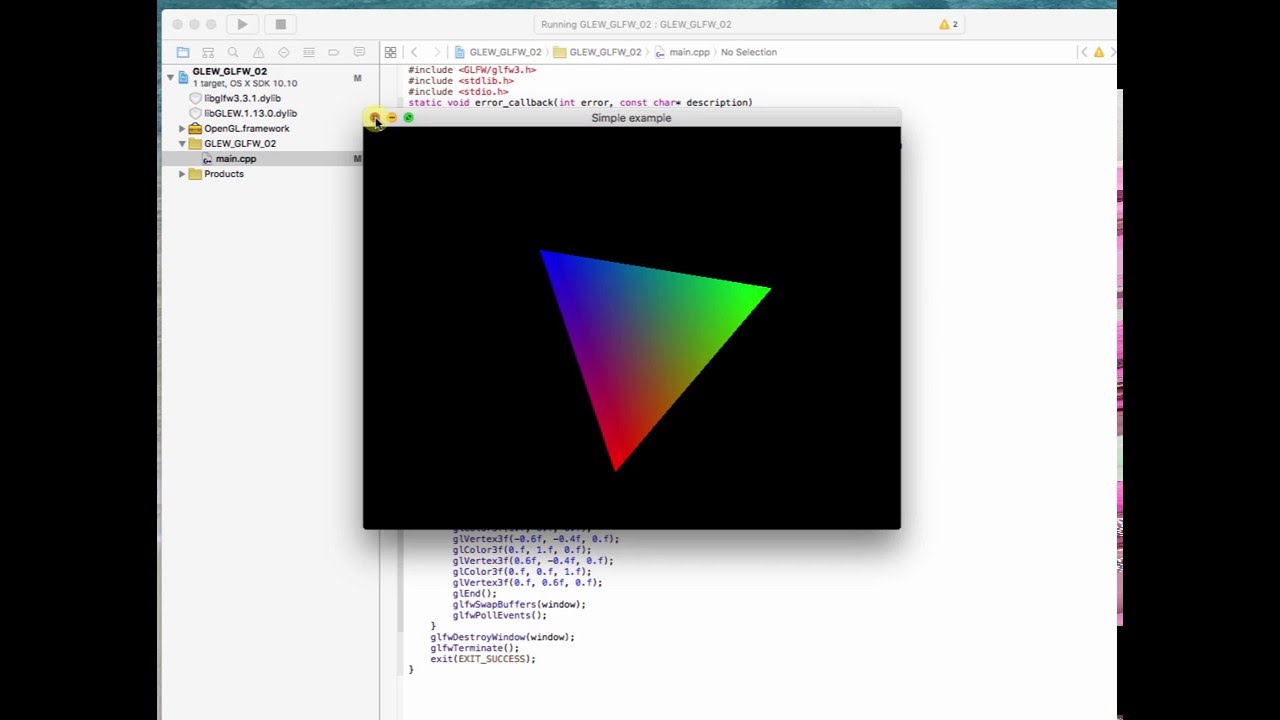
- Close the project property window. Drag and drop an OpenGL source file into the 'Source Files' branch under the 'Solution Explorer' window. Now you should be able to build and run an OpenGL program. Try the sample program 'draw_vertex.cc' attached at the bottom of this page. If successful, you'll see this image.
How to specify the path of an external file in my program so that Visual Studio can find it?
When writing your OpenGL programs, you often need to load external files such as GLSL shaders, 3D model files, and image files. Sometimes Visual Studio cannot locate these files because the files are not on Visual Studio's default search path. Here's how Visual Studio searches for files and how you should set the file path:
- Assume your program builds successfully, and your program needs to load shader files from your disk. When you run the program from within Visual Studio (VS), VS will look for these files in the 'Working Directory'. To find the 'Working Directory', open Project Properties, select 'Debugging' --> 'Working Directory', you'll find the macro $(ProjectDir). Click on the down arrow icon on the right hand side of this text box, and select <Edit..>, the 'Working Directory' window will pop up. Click on the button 'Macros>>', and scroll down to find the full path for the macro $(ProjectDir).
- By default, the 'Working Directory' is the macro $(ProjectDir), which is the folder in which your VS project file resides.
- Solution #1: Set all file paths relative to the 'Working Directory'. This is the recommended practice.
- Solution #2: Copy all the external files into the 'Working Directory'. The code will be simpler -- you just need to specify the file name, without having to worry about setting the correct file path. But all the external files are placed in one directory, along with the VS project files. It's not well organized.
- Solution #3: Specify full path for all the external files in your program. You don't need to know where the 'Working Directory' is. But this is the least flexible solution. If you share the program with others, then they'll need to reset the path. If you move your project to another folder or reset your folder name, you'll need to reset the path.
- For example, on my computer there is a sample program whose VS project file 'sample.vcxproj' is at 'D:WorkTeachingCourses2014CSC4820-6820HomeworkHomework1samplesample'. When I create this project in VS, VS automatically sets $(ProjectDir) to this folder. This is the 'Working Directory' for this project.
- In the following code sample, the program tries to load two external files (e.g. shader files) with no path specified, VS will look for them in the 'Working Directory' ('D:WorkTeachingCourses2014CSC4820-6820HomeworkHomework1samplesample')
GLuint program = InitShader( 'vshader23.glsl', 'fshader23.glsl' );
Because vshader23.glsl is not under the 'Working Directory', the program will fail. - Solution #1: Set the file path of vshader23.glsl and fshader23.glsl relative to the 'Working Directory'. In my case, vshader23.glsl is under the folder 'D:WorkTeachingCourses2014CSC4820-6820HomeworkHomework1', which is two levels above the 'Working Directory'. So I set the file path as follows. This is the recommended practice.
GLuint program = InitShader( '..vshader23.glsl', '..fshader23.glsl' ); - Solution #2: Copy vshader23.glsl and fshader23.glsl to the 'Working Directory' ('D:WorkTeachingCourses2014CSC4820-6820HomeworkHomework1samplesample'). Then the code will be simpler but the files will be less organized.
GLuint program = InitShader( 'vshader23.glsl', 'fshader23.glsl' ); - Solution #3: Set the full path for each file. This is the least flexible and least elegant solution.
GLuint program = InitShader( 'D:WorkTeachingCourses2014CSC4820-6820HomeworkHomework1vshader23.glsl', 'D:WorkTeachingCourses2014CSC4820-6820HomeworkHomework1fshader23.glsl' );
If you run your program from the command line (not from within Visual Studio), then the shader files should be in the same folder as your executable file.